
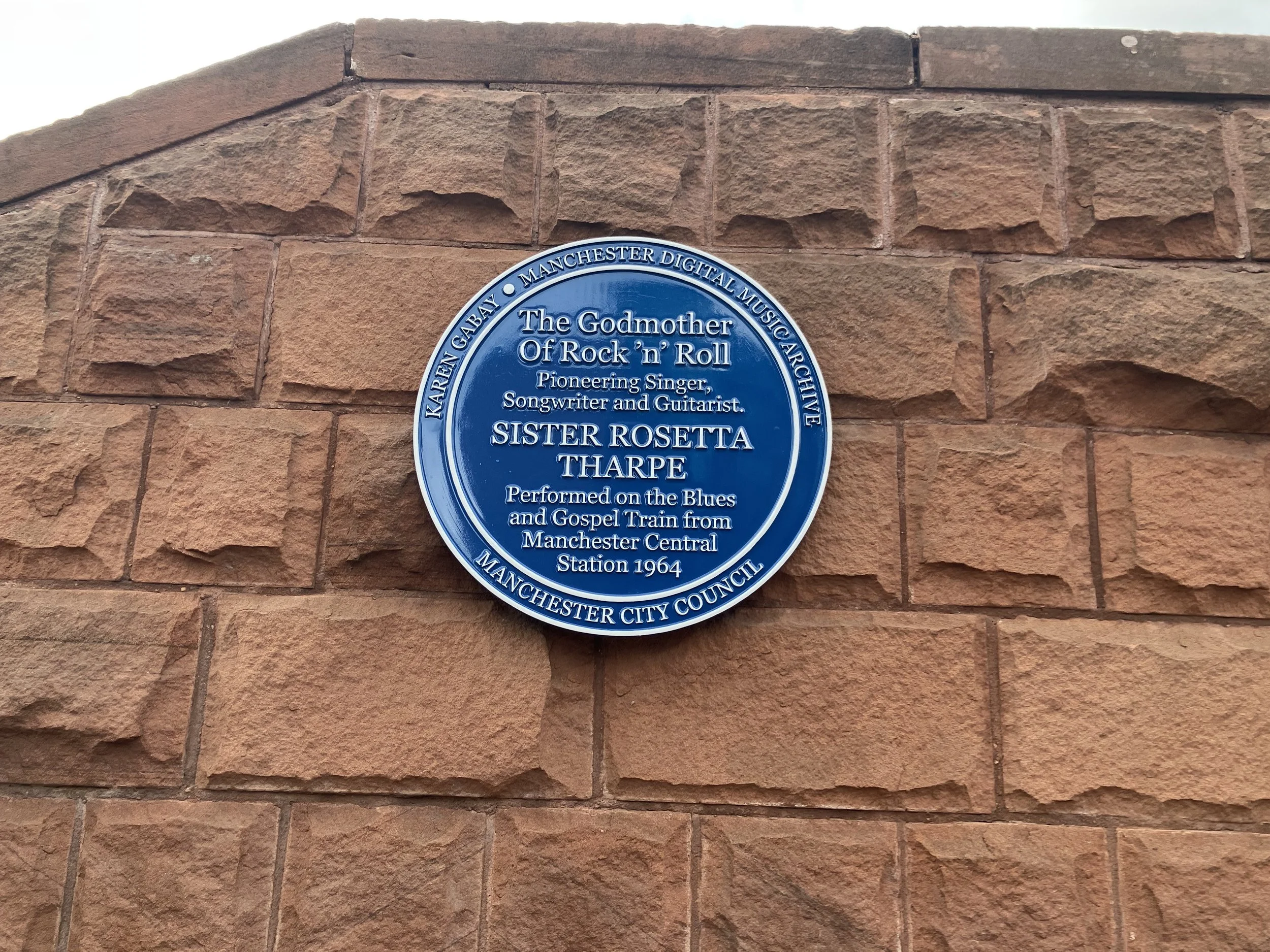
Blue plaque commemorating Sister Rosetta Tharpe’s 1964 performance on the Blues and Gospel Train from Manchester Central Station, mounted on a red sandstone wall.
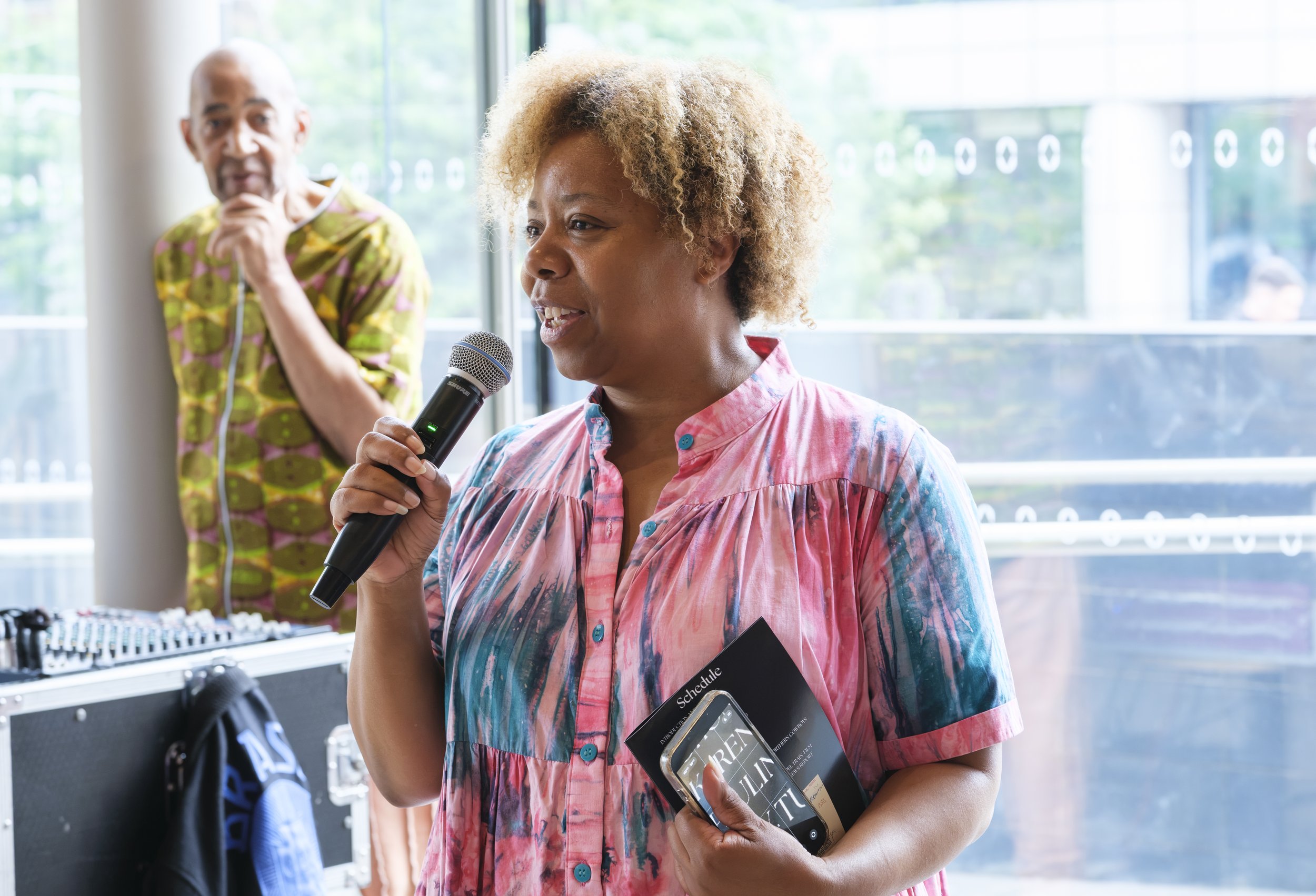
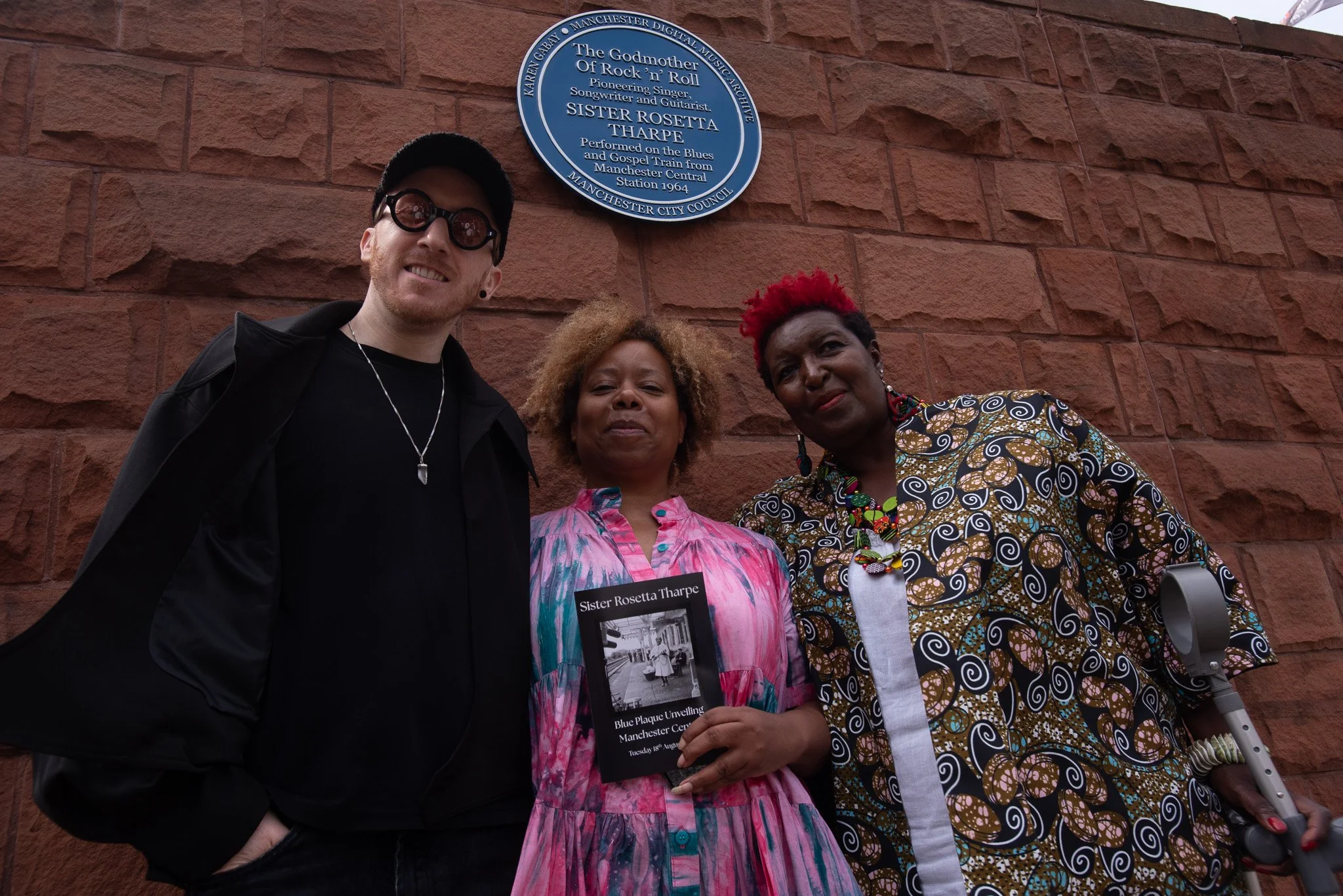
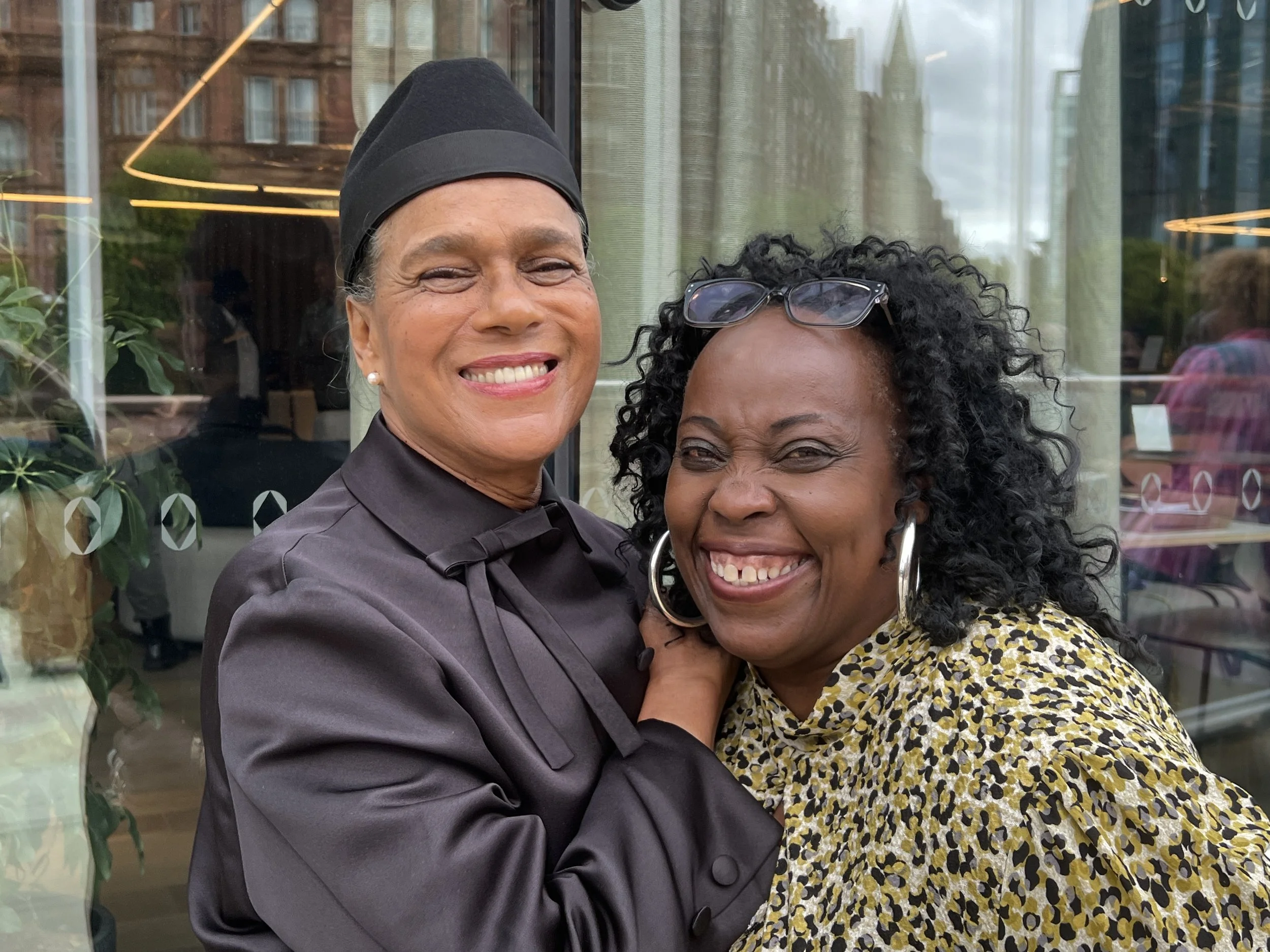
Celebrating the legacy of Black music in Greater Manchester with blue plaques. Karen Gabay celebrated the launch of a blue plaque honouring Sister Rosetta Tharpe in the city of Manchester, following approval from Manchester City Council and Manchester Central.
Karen had worked tirelessly on the initiative in collaboration with Manchester Digital Music Archive, and with support from a key group of Manchester, UK and international musicians and music creatives.
The vibrant and eclectic music scene of Manchester has long been hailed as one of the most influential in the world. However, there is an important story that remains untold - the invaluable contributions of Black musicians to this city’s rich musical heritage.
‘My whole career has been one long Sister Rosetta Tharpe impersonation’ - Chuck Berry.
Manchester, with its storied musical history, is home to an astonishingly low number of plaques and statues commemorating the outstanding achievements of Black and global majority musicians. The blue plaques for Black music initiative in Greater Manchester was launched to rectify this oversight and ensure that this history is acknowledged and celebrated for generations to come.
One of the most significant experiences in global music happened right here in the city of Manchester. Karen's vision, which began four years before the launch, was to elevate the incredible story of the day that Sister Rosetta Tharpe performed live for a group of Manchester teenagers and a Manchester television audience at a disused railway station that had been dressed as a Deep South American train station.
The live performance of Sister Rosetta Tharpe in Manchester in May 1964, has to be one of the most incredible happenings in Manchester's music history. Her appearance on The Blues and Gospel Train special on Granada TV has been replayed consistently since, but the impact of this day when she performed Didn't It Rain, Children in the Manchester rain, is not celebrated enough. Her vocals, her guitar playing and her fashion sense created and continues to inspire some of the UK's and the world's most influential musicians to pick up a guitar and perform or to work within music.
Sister Rosetta was the true architect of rock ‘n’ roll and soul music bringing her gospel, blues and rock music to England and Europe and creating the bedrock for popular music. No-one could play the guitar like SIster RT and she heavily influenced the giants of music including Chuck Berry, Elvis, Little Richard, The Rolling Stones and in recent times Ruby Turner, Sir Tom Jones, Shingai, Brittany Howard and Tracy Chapman.
International supporters of the campaign included Pauline Black, Ruby Turner, P.P. Arnold, Kym Mazelle, Canid Staton, Gloria Jones, Shawn Stockman (Boyz II Men), Lizz Wright, Brian Jackson, Lady Blackbird, Nik West (Prince, Larry Graham), Erik Griggs (producer of Eminem, Dr Dre), Daley, Aziz Ibrahim, Derrick Johnson, Aniff Akinola, Yvonne Shelton and Michael Mwenso.
Importantly, Johnnie Hamp, the TV producer of the Granada special The Blues and Gospel Train, her great niece Teanna and The Culture Rock Griot Samantha Hollins were firm supporters of a blue plaque for Rosetta. As an artist, she continues to inspire musicians both emerging and established to innovate, create and perform with style. Karen had also advocated for her contribution to be acknowledged at the MOBO Awards in Manchester, where she was saluted by The Nova Twins in their acceptance speech for Best Alternative R&B.
Sister Rosetta was buried in an unmarked grave in 1973, and it has only been in recent years that her contribution to the foundation of popular music has been established. The city of Manchester supported Rosetta gaining her rightful place and platform in Manchester history through the launch.
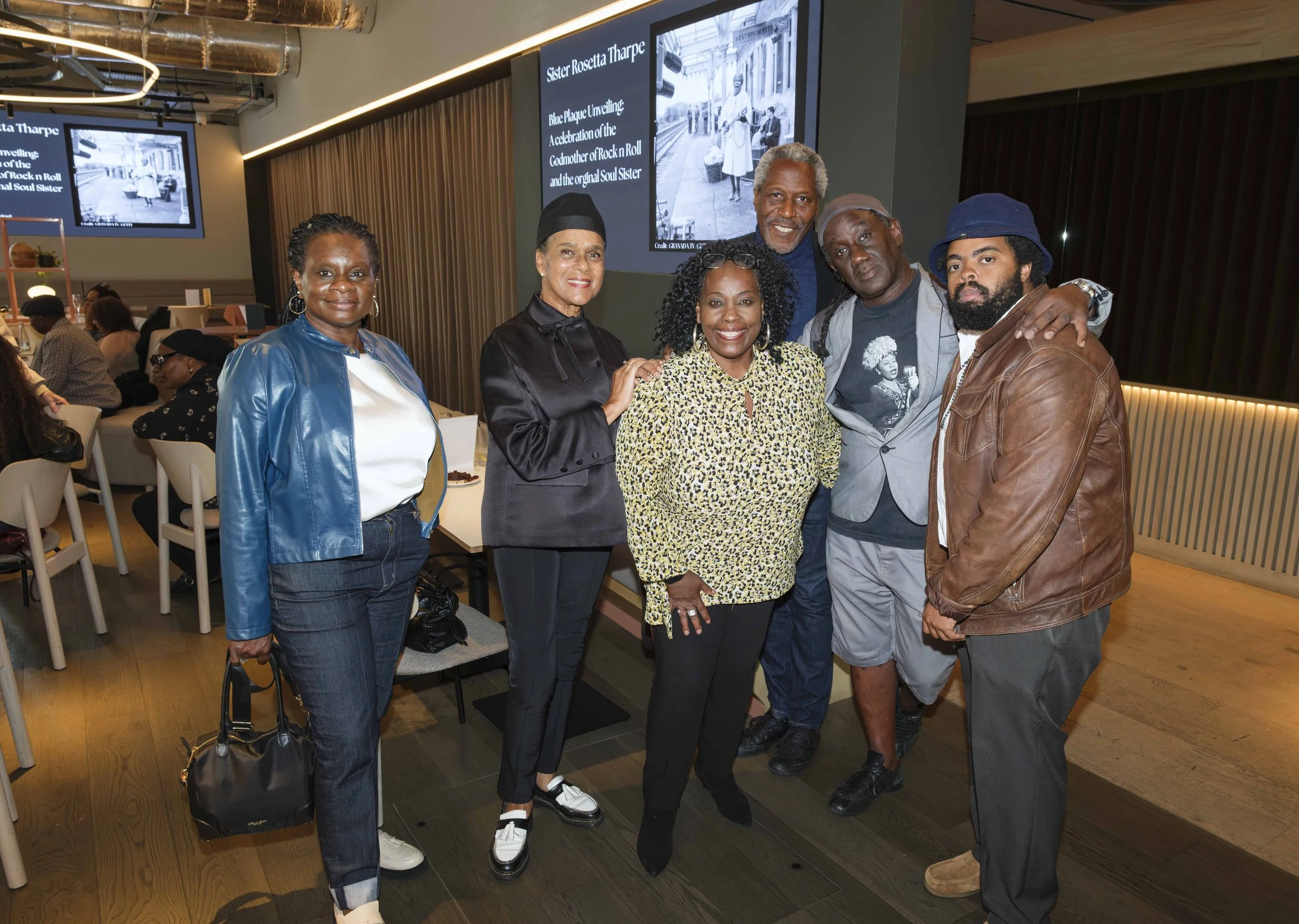
The plaque for Rosetta was installed at Manchester Central in August 2026. The event had the endorsement of Sister Rosetta's niece, who oversees her foundation, and the support of Manchester's Music Commission, The Culture Rock Griot in Philadelphia, I Love Manchester and The British Pop Culture Archive.
Following the launch, plans for future years included a Sister Rosetta Day in Manchester and collaborations with schools, universities and musicians.
Blue Plaque Programme
The first phase of our campaign was the installation of blue plaques for women, commemorating three of the most unsung, under-rated, and gifted women of the 20th and 21st century, with strong associations to the city.
The first two blue plaques installed were for the singer and songwriter Denise Johnson, and vocalist. songwriter and producer Diane Charlemagne, both artists were born and raised in Manchester. These remarkable women were essential to the success of some of the most treasured tracks of the dancefloors and British music culture.
Diane Charlemagne’s vocals graced songs that included 52nd Street’s "Tell Me How it Feels," Goldie's "Inner City Life,” & “The Key, The Secret “with Urban Cookie Collective, and she toured with the world with Moby including their memorable Glastonbury show in 2003. Denise Johnson, like Denise recorded iconic vocals across genres, she sang the underground classic with Fifth of Heaven’s Just A Little More & Primal Scream's "Screamadelica."
Denise went onto write and produce her captivating and fiercely independent debut album, “Where Does It Go” that was posthumously released in 2020. She passed away 3 months before the release of her debut album.
Denise and Diane are undoubtedly two of the finest vocalists that Manchester and the UK has ever produced. The call for recognition for these singer/songwriters was supported by musicians world-wide. A second phase of the campaign was planned to celebrate male artists who made a huge contribution to the city.
Published by
Greater Manchester Music Commission